The Saddest Part is That it Didn’t Surprise Us

We were all horrified last week with the news that the bodies of 215 children had been found on the grounds of a Residential School near Kamloops. It makes the horror of residential schools tangible. What made me profoundly sad, though, was that this was no surprise to any of us.

Anyone who knows anything about residential schools knows what went on there. I know my generation didn’t learn about it in school and my sons learned almost nothing about it but we’ve all heard about it now. For me, a visit to the Canadian Museum of Human Rights in Winnipeg was a profoundly moving experience as I learned much much more grim detail about how the schools worked. Even if you don’t know about residential schools you will have heard about the lack of clean water in many aboriginal communities, heard the heartbreaking stories of youth suicide, or seen the statistics about the number of aboriginal kids in foster care. Regardless of what your insight is, you know that Canada has a shameful record in its treatment of and relationship with aboriginal peoples. As Canadians we have this willful ignorance of the real meaning of the lived experiences of aboriginal peoples, both today and in the past. We know its not good but we don’t want to know too much. That’s why we are horrified when we get tangible reporting (like 215 children buried on the grounds of a school) but we are not surprised.

Canadians are not unique. I read this week about the Tulsa Massacre which happened 100 years ago. White mobs essentially wiped a thriving black community off the map driving out 10,000 residents and killing 300 of them. It is a horrific story but not a surprising one. There was a willful suppression of the story in Tulsa and across America as it is a painful artifact of the treatment of blacks in that country. We are reminded regularly of the inequity of experience and opportunity that continues in both the US and Canada.

When we get news like that of the 215 children we get angry and sad. We lower flags to half mast and assert that all children matter. All of this is good. But we need to be shocked that this doesn’t surprise us. We need to realize that we’ve come to accept these examples of that experience and been numbed to them. We need to stand up and say that the fact that we are not surprised or shocked is unacceptable and to push ourselves and our governments to do better. There aren’t kids in residential schools any more but there are innumerable examples of racism and inequity and that we can and should do better. Let’s commit to keeping the momentum of our wish to do better. When the flags go back to flying at the top of the mast we should still be calling out racism and pushing our governments to do better. We may disagree on the specifics of policy but I hope we don’t disagree on the need for action.

Let’s work towards a situation in which we are both horrified and surprised when stories like this come out – it means that they are happening less.

Dr. Biden and Me

I have to admit that when the issue of the Wall Street Journal article on Jill Biden first blew up I thought that it was something of a tempest in a teapot. Perhaps I’ve become desensitized to the rhetoric from both sides of the political spectrum or prefer to just ignore the bluster and resulting blowback. In the end, however, I felt I had to chime in and provide my perspective.

I have a PhD. I am proud of the work I did to get it. It allowed me to get my dream job. It also provided me a set of skills to contribute to academic research and a broader public discussion of issues I believe are important. It also gave me an appreciation for the hard work others do to get a PhD. These are bright and accomplished people and deserve our respect. That’s not to say that people without PhD’s don’t make positive contributions, but a PhD means someone understands a subject deeply and knows what they are talking about.

I don’t often use the title “Dr.” It’s interesting that my wife is dentist (also a Dr.) and we are often addressed as Dr Howe and Mr von Massow. I’m ok with that. I think sometimes that people are intimidated by the title and so actively discourage its use and I just choose not to use it. Its sometimes easier to engage someone in discussion if I’m simply Mike. I am also conscious that sometimes being a PhD and an academic actually hurts my credibility (the disdain for science and research is a topic for another post) and so I just avoid it. I perhaps occasionally suffer from imposter syndrome so avoid drawing more attention to myself. But all of this is my choice. I have an advantage that I am a middle aged white guy. This is another example of privilege. I understand that many of you will roll your eyes when I say that, but that’s again a lack of lived experience.

I have several incredibly bright colleagues who happen to be female and younger than I. I am privileged (a different context) to work with them. You’d be surprised at how often people in meetings assume that they are graduate students or research associates rather than professors who are the leader of the project. People often assume I’m the leader of the project by default. Even when they know my colleagues are faculty, they sometimes clearly treat us differently. One way of protecting them is to use the honorific Dr. to stake a claim to the position and respect they deserve. I’d rather we didn’t need to do it but we most definitely still do. This article and my experience makes that clear. Mr. Epstein clearly wants to demean her but diminishing her accomplishment. It is all to common and needs to be called out.

I think this is also reflective of a broader societal disdain for academia. To a degree this is earned. I believe we need to do a better job of communicating the value of research and what specific findings mean but, again, that is a topic for another day. I think this disdain is especially true for for some disciplines. I expect that, had Dr. Biden had a PhD in Physics, this attack might have been less likely. Even people with doctorates perceive some disciplines as lesser than their own. If this happens within the academy its is hardly surprising it happens in broader society.

Mr. Epstein highlights that many people, like me, chose not to use the honorific. He also highlights that many people get honorary degrees and then use the honorific. His disdain for Dr.Biden’s use of the honorific highlights the very reason she likely feels the need to use it. I noticed that he didn’t write about Dr. Atlas’ opinions on the pandemic. While he is a Dr. (a radiologist I believe) he is not an epidemiologist, a virologist or for that matter an economist but few on the right criticized his opinions on mask wearing and lockdowns which were not his area of expertise. Seems a double standard.

There are a couple of kernels of truth in what Mr. Epstein said but he moved from there to a misguided and misogynistic (he said she should be thrilled to be called First Lady Jill Biden) attack. I felt I had to stand up and say go for it. There’s a Dr. in the White House and perhaps she will contribute effectively to the discussion on post-secondary education. She should, she knows more than almost all of us about the subject. She’s a smart and articulate worman – she likely knows a more about a lot of things than many of us – including Mr. Epstein. Trust me, I’m a Doctor.

I’m not OK but I will be.

I am struggling.  There I said it (well at least I wrote it down – we will see if I post it). Many people are.  I don’t think enough of us acknowledge it.  Too many people feel like they are struggling alone.  It might make it easier for someone else to hear that many of us are in the same boat. It’s normal and its ok – particularly in a difficult year like this one. If we share the burden it will get easier.

I’m not looking for sympathy. I am not so different from many people.  In many ways I’m lucky.  I still have a job and continue to work.  I am working from home but still have a good income, a comfortable place to live and work, space to walk and enjoy the outdoors while keeping my distance, and my little family has stayed healthy.  But there are things that have been tough.  I’m highlighting that we’re all dealing with things that others may not see or understand.  Maybe we can all have a bit more empathy for those we interact with. A bit of understanding can go a long way.

I have two objectives.  You’ve seen them already.  To share so people can see they are not the only ones (at least I hope I’m not the only one) and encourage us all to have some empathy for those who are not behaving in a way we expect them to. I think things are going to get harder before they get easier and that means we need to be more understanding as all of us are under more stress. The holidays can be a tough time for many people and this will be a tougher year for all of us.

If anyone has read this far (again assuming I’ve posted this and not just done a brain dump on paper) and needs to chat please reach out to me or to anyone.  We can support each other through this.

What’s Up With Me?

I have lot’s of “symptoms.”

A big thing is reduced resilience. It takes so much less to knock me off course now.  I feel like I’m always walking too close to the edge.

I have days where I struggle with getting traction.  I stare at my screen (I’m working from home and don’t get out much).  I have a ton to do and am my usual horribly overcommitted self but I struggle to get motivated and started.  This compounds my stress.  It’s a vicious circle.  I find myself watching those sappy dog rescue videos on facebook. I play silly games on my ipad or phone. I find a reason to putter around on something else. I do have very rewarding and productive days, but there are fewer than there usually are.

I feel sad and anxious.  This makes me grumpy and hard to be around. This is always a tough time of year for me. I have a light for seasonal affective disorder and work hard to get exercise and sleep to mitigate it. 

I’m sleeping poorly. I’ve always had some challenges with insomnia but its worse now.  Its likely why the first two points happen.

I feel guilty. I am harder to be around. I am not being as productive as I should be and am letting my colleagues down.

Why Is It Happening?

Well duhhh!  We’re in a global pandemic.  That’s stressful.  Our lives are changed.  We have less freedom.  Many are feeling financial stress. Work changed.  We had to pivot to online teaching. In many ways our commitments went up as our movement and social interactions were restricted. I am trying to do too much.  I’ve done about 250 media interviews since March.  I’ve participated in two articles for special issues on the impacts of COVID. We pivoted a research project to measuring food waste after COVID. We changed all of our courses to reflect the new short-term reality. I am writing a whole new course for a graduate program. I need to know my limits.

My Mother died in March – not of COVID and luckily in a time when we could be with her in the hospital when she passed.  It’s hard – harder than I thought it would be.  Its also caused some tension with my sister which adds to the stress. Many people have lost loved ones during the pandemic.

My Dad is declining. Its been very hard for him.  He lost his partner of almost 60 years.  He moved into a new place and immediately got locked down.  His dementia is advancing quite quickly.  I feel like the isolation of COVID is accelerating his decline.  The loss of my Mother was relatively quick.  I feel like I am losing my Dad a bit every day.  I visit 3 or 4 times a week because its important.  Its also incredibly difficult.

I am an extrovert and the lack of social interaction is horrible. I miss just chatting with people.  I miss a quick game of cards at lunch. I miss running in to people on campus or in town. You forget how much energy you get from simply interacting with people.

I worry about my family. Work is hard. They are struggling to and I am trying to be supportive.

I worry about my students.  We are doing our best but its simply not the same.  I see many of them struggling and I worry that it will be worse in the winter semester. I wish I could do more.

I despair (literally) for our society.  I see the divisions and harsh rhetoric. We can’t seem to disagree and have reasoned debate anymore.  I see the virulent bias – racism, sexism that is undeniable. I can’t watch the news. The vitriol on social media is unbelievable. Its great to contribute to or read a reasoned discussion but that seems so rare nowadays. I may be more sensitive to it now but it is what it is.

I know others have other things. Isolation. Loneliness. Fear of loss of livelihood. Fear of loss of businesses that they’ve dedicated their lives to. There are so many more.

What Can We Do?

Empathy!!!! You might not like the choices people are making but you probably don’t understand why they are making them.  Sure there are a$$holes doing dumb things.  I’d rather take it easy on an a$$hole and support someone who needs it than unload on someone who I think is making bad choices but who is just struggling.  If you think someone is struggling reach out.  They may not want help but you never know.  At the very least just be kind.

Exercise!  I am working on getting more exercise.  I will feel better and hopefully sleep better.

Say No!  I should prioritize things and not take on lower priority things.

Have fun! There are parts of my job I love. I am focusing on those more.  I love my work blog and podcast.  I love interacting with students.  I also love photography and am trying to take time to just relax and take pictures. We ordered a frisbee golf net for the holidays and are going to play around our yard and neighbourhood.  We are playing more games to relax as a family.

Relax!  See above.  Take some time for yourself.

Interact!  I have amazing friends and colleagues.  Many have reached out just to check in.  Many schedule regular interactions.  Zoom beers are less fun than live beers but WAAAY more fun than sitting alone in my office. I’ve developed this network of walkers that I meet regularly when walking the dogs on the trails. We chat regularly.  We talk about feeling blue.  We talk about the loss of parents.  We talk about the struggle in teaching. We talk about isolation. We talk about the weather. We talk about birds.  We talk about families.  We just talk. I don’t know many of their names but I do know I look forward to seeing them.  We help each other. I feel better just having written this.

If you’ve read this far, good for you and thanks. I will be ok.  We can and will get through this. We can make it easier by being smart. Be kind. If you need help ask. 

A Response to An American Friend

The last months have seen an extremely divisive election in the US. Its been painful to watch a country with such a history of leadership and an exemplar of a western democracy tear itself apart. The election has been “called” but it is worth noting that many Americans didn’t get the outcome they wanted and some even feel like they were cheated out of a rightful win.

A friend of mine voted for Donald Trump. I wouldn’t have but I didn’t have a vote. He’s a good person. In the days leading up to the election he posted a link to an op-ed that presented some reasons to vote for Donald Trump. I was interested to read it to better understand that perspective. I was intrigued by the note but disagreed strongly with much of what was said. I wondered for a while if it was worth responding given the election is over and I am a Canadian. In the end I felt it was worth writing down my thoughts not least because the article emphasized the importance of having a free exchange of ideas. It has also been bugging me and this blog is supposed to be a venue for me to get things out and hopefully, leave them behind. As was the case with the op-ed, I am giving my opinion and may be as subject to confirmation bias as the author was but here goes. I am doing it because we need to speak up regularly or we will all just go into our own little social media echo chambers.

One of the first points he makes is about libertarianism. I get that. I am inclined to think there are areas that the government shouldn’t be involved in. My line might be a bit different than his but I agree wholeheartedly that the government has no role in legislating morality. I don’t believe the government has any role in deciding who can get married, who you worship (or don’t). I also don’t think the government should legislate on abortion. That doesn’t make me pro-abortion but makes me pro-choice. Its not my place to tell others what to choose. So we start with some common ground.

I also think that he makes a good point about the Democratic Party. The US is more conservative on average than Canada is. The policy proposals of some Democrats are making many Republicans significantly uncomfortable. This is one of the problems with a two party system. The increased polarization in Canada is propping up the Liberals which drives some on the right in Canada nuts but that’s a topic for another post. There is no mid-point option in the US. The primary process to select candidates means you get more extreme candidates than might be ideally electable. If you look at the election results in the US, the Republicans fared remarkably well. Many Republican inclined voters chose what they thought was the lesser of two evils, held their noses and voted Trump. I wouldn’t have but I don’t think they were all “deplorables.”

Race

That is, however, one of the last points of agreement we had. The author says: “I fundamentally reject the idea that America is a racist country. In fact, I think America is the least racist country in the history of the world.” This is, in my view at best naïve and at worst delusional. Perhaps part of the difference is semantics (is the country racist or are some of the people in it racists) but it is clear that racism remains an issue across the globe. There are definitely countries in world where there is more equality than in the US but everyone has issues. The examples highlighted as evidence of a lack of racism is that Asian men make more money than other racial groups. That can’t be true in a “hopelessly racist country” can it? This is a perfect example of the misuse of statistics. How can you argue that high earning for Asian men is a reflection of the lack of racism but the lower than average earnings of Hispanics and Blacks are not a reflection of racial inequality. This is the epitome of confirmation bias or the purposeful misrepresentation of statistics to make the point you want to make. Median (not average) Asian household incomes are higher than others in the US. But median Black households are a third lower than the national median and Hispanic households are are 17% lower. That is not to say that Asians have it great. Asians have the highest level of income inequality in the US. Some are doing very well but many still are among the lowest earners. Many factors contribute to this difference in incomes but if you are going to tout one group as evidence of the lack of racism you can’t ignore the other outcomes and say they don’t have anything to do with racism.

He also highlights immigration as evidence that of a lack of racism because people are choosing the US and taking real risks to get there. In this case he is conflating both illegal and legal immigration. Part of the reason the US is getting lots of immigration is related to real economic opportunity. It is also due to convenience. If Canada was below the US instead of above it, there would be a significantly larger number of people trying to cross the border into Canada. Its worth noting that that there are large numbers of (primarily racial minorities) people trying to cross the border from the US into Canada which is also a significant political issue here. Europe is getting flooded with migrants because of its proximity to North Africa.

It is also important to note that some of the legal and illegal immigrants are leaving horrific conditions to try to find somewhere, anywhere, that’s better. That is setting a pretty low standard. One hopes that we as nations aspire to be better than just a bit better than some of the abysmal failed states that people are flocking out of.

The US does take in a large number of immigrants which does undeniably suggest that there is some attractiveness there. But on a per capita basis many countries, including Canada, take in more immigrants than the US does. Some of those differences will be due to policy differences but culture and living conditions are important here.

Reparations may or may not be an appropriate approach to achieving equality but denying the difference in opportunity and safety is simply putting your head in the sand. It could also just be unconscious bias. Privilege is real. If you haven’t had the experience you might not understand the disadvantage. Its not universal. Non-whites are more likely to see the advantage of being white. There are also whites who are disadvantaged. But the relative disadvantage and treatment is clearly affected by race. Talk to a person of colour about their lived experience and you will have your eyes opened – as relevant for Canadians as Americans. All of that and I haven’t talked about some of the issues that have drawn a lot of attention in the US and are indisputably race related.

I’ve had people say that the fact that Obama was President shows an absence of racism. First, there were very many Americans who didn’t vote for him and some of them didn’t simply because he was black. Ted Cruz was born in Canada. You heard a lot less about that than you did about Obama’s birth and he actually was born in the US. Second, there are circumstances that some people of colour will succeed DESPITE their disadvantages not because racism doesn’t exist – see the income statistics above again.

There are many Republicans who understand and acknowledge that racism exists. The disagreement is how best to address it. I would argue that Trump is a racist or at least that he was willing (keen even) to leverage racial divisions to his own advantage. This is not a Republican position, it is a Trump one.

Cancel Culture

The author is correct that we have become too quick to shout down ideas that disagree with ours – I am hopeful that this is a respectful disagreement. We might disagree on where the line is – I believe that we have an obligation to call out hate. There is bias in the media – on both sides of the political spectrum. Its easy to get to the fact that your ideas are being edited more than those of others but cancel culture is not a uniquely Democrat phenomenon. An American friend told a story about his Republican friend getting spit on while observing a right wing vote protest. He was wearing a mask. The intolerance of opposing views has to stop but I’m not sure this is a one sided issue and, frankly, as an outside observer, Donald Trump is one of the worst at attacking those that disagree with him.

COVID

COVID has been a profound global challenge. It has been difficult to strike a balance between ongoing economic activity and preventing the uncontrolled spread. I am not an infectious disease specialist but there seems to be some credence to the argument that the federal government in the US has mismanaged the fight against COVID. At the very least the politicization of the wearing of masks is unbelievable. There hasn’t been a national lockdown as far as I can see. There have been differences in state level closures because most of the decisions are the responsibility of the states. There have been Republican governed states that have been more aggressive than other states but there has been some degree of party line and this is largely due to the tone set by the President. He has consistently downplayed the threat of the virus for political gain. Ignoring that and saying that Biden will impose a lockdown (which as I understand he can’t) despite his assertions that he won’t is political hackery on par with those called out earlier in the article.

China did lie or at least withhold information in the early days. But this administration also lied and misled.

“While America has had many struggles, our national COVID death rate, per capita, is lower than many European democracies.” I suppose it depends on how you define “many.” I looked at an American source (Johns Hopkins University) which has the United States at the 13th highest per capita death rate in the world – behind Belgium, Spain, and the United Kingdom. There are a couple of tiny principalities but small samples make them moot.

China

“There’s a true battle over who will dominate the 21st century around the globe. Will it be China, with their lack of basic human rights, their trampling of free speech values, and their derogation of freedom of religion and the free exchange of ideas on the internet,”

I agree that China is attempting to become a dominant power in the world. We need to put a stake in the ground and stand up for what’s right.

“Donald Trump is the most aggressive confronter of China in my lifetime.” I couldn’t disagree more. Donald Trump has been silent on anything except the trade imbalance. There have been multiple opportunities to stand up to China (the Uighers, Hong Kong) when it comes to human rights and freedom of speech. The Trump administration has been the least vocal of any in my memory. This is true in cases of abuses in other countries too. The Trump administration has imposed tariffs on China (which mostly costs Americans money) in an effort to re-balance trade. The Republicans have been historically the party recognizing the benefits of trade. In this case the only confronting this administration has done is on trade and that has been largely unsuccessful. It could also be argued that the Trump administration has done exactly the same thing to other Western democracies (see Canada among others) so its hard to argue that the little bit of standing up he has done is relative to correcting bad behaviour relative to human rights or free speech.

Canada detained Meng Wanzhou at the request of the US administration. This is an influential Chinese national who is accused of bypassing the sanctions against Iran. The Chinese have since arbitrarily detained two Canadians and taken significant trade action against Canada in retaliation. We did it because it was the right thing to do and upheld the rule of law. Donald Trump said he was willing to trade the legal action in a negotiation for a trade deal. That hung Canada out to dry. That’s hardly a principled position of moral leadership. That’s pandering.

Supreme Court

I agree that expanding the supreme court would be a bad thing. It would undermine the role of the court. That said, I would argue that the about face the Republicans have taken with respect to confirmations in an election year were also a blow to the foundation of democratic principles. Neither outcome looks good on America.

American Exceptionalism and Capitalist Democracy

America has been a beacon of leadership in the world for the past century. That is hard to deny. As a Canadian I would argue that we’ve also been a positive influence but we simply don’t have the economic, military, or population might to play at the same level. American has been admired (and feared). I understand, if don’t always agree with the concept of American exceptionalism. I will say though that Donald Trump (not Republicans but this administration) has significantly eroded that moral leadership. He hasn’t stood up to dictators or bad actors in the world. If anything he’s cozied up to them. He left the Paris Accord. He left the Iran Nuclear Agreement. He’s waged political battles around the world. It goes on. If it was one or two of them you could chalk it up to policy differences. In truth, I agree with Trump about the United Nations. Its paid for in large part by the Americans and the countries with vetoes behave badly with impunity. But there has been a significant push towards disengagement and self interest -Trump and not America. In sum, however, it has undermined the ability of American to be a force for good in the world. Donald Trump has singlehandedly undermined American exceptionalism and global leadership.

As for democracy, we are witnessing a farce in the days before and after the election. All Republicans except Trump made gains in this US election. The attacks on the credibility of the election are unfathomable except to be the desperate flailing of a politician who has lost his people. Undermining democracy like this is unbecoming and is, frankly, making the US a laughingstock around the world. Add this to the process of gerrymandering (which disproportionately disenfranchises people of colour – see racism above) and the US is hardly advancing the cause of democracy in the broader world. We expect and hope for more leadership from the country.

Now, as I’ve reached the end of my rant I feel better. I don’t expect you (or anyone frankly) to read to the end (or even start) but I had to get it off my chest. We miss the America that leads in the world – even if we don’t always agree with it. Donald Trump took that away.

A New Direction

As part of my new OAC Chair in Food System Leadership, we have launched a new website which will replace this blog.  The new website gives us some improved functionality and a platform for not only a blog but also a podcast and a home base for our Food Trends Report.  Thank you for following here and we hope you join us at our new location.  foodfocusguelph.ca

The Two Key Issues on the Table to Bring Canada back in to NAFTA

This was also published on the conversation.com

Negotiations for a revised North American Free Trade Agreement have been ongoing for more than a year, but now it’s crunch time — especially for Canada.

What happens in the coming days will determine if NAFTA survives as a three-country trade pact or whether Canada will be left on the sidelines.

Since U.S. President Donald Trump announced the United States had a deal with Mexico that could replace NAFTA, Canadian negotiators have been putting on a brave face publicly. Foreign Affairs Minister Chrystia Freeland was optimisitc when talks took a break before the Labour Day weekend and Prime Minister Justin Trudeau has said “no NAFTA deal is better than a bad NAFTA deal.”

Trump, for his part, took to Twitter to keep up the pressure on Canada.

Donald J. Trump

✔@realDonaldTrump

There is no political necessity to keep Canada in the new NAFTA deal. If we don’t make a fair deal for the U.S. after decades of abuse, Canada will be out. Congress should not interfere w/ these negotiations or I will simply terminate NAFTA entirely & we will be far better off…

There are two significant issues still on the table: How to resolve inevitable trade disputes and Canada’s policies that protect its dairy industry from foreign competition.

How will disputes be resolved?

The first sticking point is the existing dispute settlement mechanism — particularly relative to anti-dumping or countervailing duties. This is known as Chapter 19 in the current NAFTA pact.

Currently, each government can review the actions of others and make a determination of whether trade action against a sector is warranted. These determinations can be appealed to the relevant court in each country.

If the dispute is not resolved, it can be appealed to the NAFTA Free Trade Commission and further to a bilateral panel to arbitrate the dispute. The panellists (two from each country and an alternating chair) are appointed by the disputants. The decisions of these panels are binding. It is this last provision that apparently is the sticking point for U.S. negotiators.

It is worth noting this aversion to dispute resolution is not specific to the Trump administration. When the original Canada-U.S. free trade agreement was negotiated 30 years ago, Brian Mulroney’s Conservative government also threatened to walk away without a deal over the issue on how to resolve disputes. In 1988, U.S. negotiators only conceded at the 11th hour.

Leave it to the courts

The United States believes domestic court systems should be able to effectively determine the legality of specific actions and, as such, these panels are an affront to national sovereignty. Canada feels Chapter 19 is an essential element to ensure the fair implementation of freer trade.

Those who believe the panels are not necessary or effective point to the fact that Canada has won several findings in the softwood lumber dispute without actually getting a positive resolution. Past U.S. administrations have also ignored panel findings and forced the Canadians to strike compromise deals or face continued countervailing duties. The U.S. lumber industry remains one of the most vocal opponents of these dispute settlement panels.

But others in all three countries argue the panels are an essential protection despite not being frequently used in the past 10 years. There is little sign of bias because these panel findings are frequently unanimous.

In the end, there will be a mechanism to resolve disputes. Canada will have to decide whether retaining the panels is worth not making a deal. The U.S. will have to decide how far it wants to go on making concessions, balancing its desire for more sovereignty with the political reality of striking a deal that Congress will approve — a critical step in the final implementation of any new agreement.

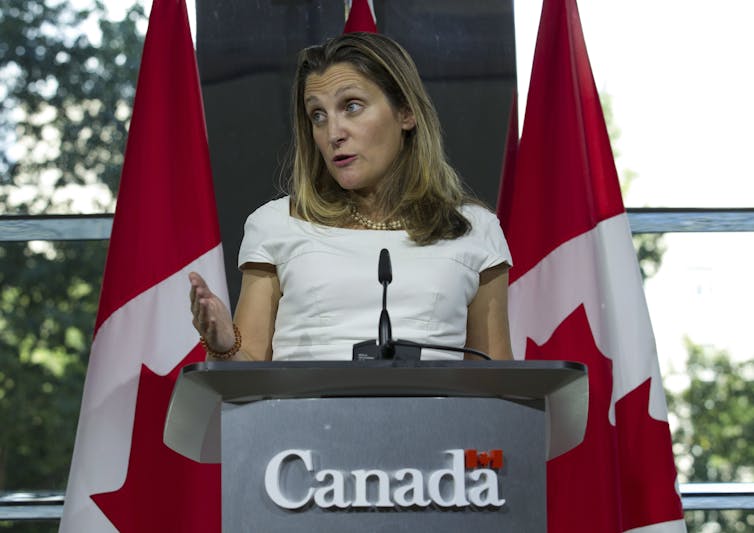
Canada’s Foreign Affairs Minister Chrystia Freeland speaks during a news conference at the Canadian embassy after talks at the Office of the United States Trade Representative in Washington, D.C., on Aug. 31, 2018. (AP Photo/Jose Luis Magana)

Canada’s dairy policies a major issue

Canada’s supply management system uses quotas supported by tariffs to stabilize its dairy markets. Many countries have support programs for agriculture generally and the dairy market specifically.

While there is some criticism within Canada of supply management — most notably Maxime Bernier’s split from the Conservatives — there is strong support among both the Liberal government and the opposition Conservatives for protecting the dairy industry.

Access to the Canadian dairy market has been somewhat of an irritant in past trade negotiations.

From the beginning, supply-managed commodities were protected by tariffs, but some product has been allowed in (based on historical import shares) using import quotas. Products coming in under these import quotas are not subject to the high tariffs. The U.S. also uses import quotas and high tariffs to protect its dairy and other industries.

Canada has opened access for others

As part of other new trade agreements, Canada has provided additional access (through import quotas) to the market.

The Comprehensive Economic and Trade Agreement (CETA) between Canada and the European Union provided for additional access for European dairy products. The Trans Pacific Partnership (TPP) agreement also had provisions for additional market access — including the U.S. market, until the Trump administration withdrew from TPP.

Dairy became a specific irritant early in the Trump administration.

Shifting demand for milk components meant surpluses for milk protein, used to create a product called diafiltered milk. Because it’s a new product, U.S. diafiltered milk is not covered under previous trade agreements. This meant it could come in to Canadian processors, particularly cheese manufacturers, tariff-free.

In retaliation, Canadian milk protein producers first lobbied the government for protection and when none was forthcoming, changed pricing to protect their market. That in turn caused disruption in some U.S. markets — particularly in Wisconsin, an important state for Trump politically.

Even with the decreased volume in diafiltered milk, the U.S. still has an export surplus with Canada in dairy products. Regardless, it appears that this issue is a particular irritant for Trump.

Donald J. Trump

✔@realDonaldTrump

Prime Minister Trudeau is being so indignant, bringing up the relationship that the U.S. and Canada had over the many years and all sorts of other things…but he doesn’t bring up the fact that they charge us up to 300% on dairy — hurting our Farmers, killing our Agriculture!

Over-production, low prices

The U.S. dairy industry, like many others around the world, is struggling with over-production and low prices. The U.S. also has a number of programs in place to support the dairy industry, which would need to be taken into consideration in any NAFTA negotiations around dairy trade.

The irony is the structure of some of the U.S. dairy support programs may actually be contributing to the over-production — surplus products are bought to support prices, which sends a signal to keep producing too much.

Completely open trade with Canada will not solve the issues facing the U.S. dairy industry, not least because the Canadian market is much smaller than the U.S. domestic market.

In the end, Canada is unlikely to yield on supply management. If a concession is made, it is likely to be in increased access. Canada had already provided an increase in access in the TPP negotiations.

This would seem to be an area of potential concession that would provide Trump with a “win” for farmers and allow the Canadians to sustain their domestic program. It would not be without pain for the Canadian industry, but may be the path to an agreement.

The final chapter of these lengthy NAFTA talks will come down to one key point: Is compromise possible?

Restaurants not only feed us, they shape our food preferences.

This was also published on the conversation.com

Restaurants are playing an increasingly important role in the food culture of North Americans.

In the United States, food prepared outside the home represents more than 50 per cent of the food dollar, or more than US$800 billion a year.

Canadians spend $80 billion annually in restaurants, spending almost 30 per cent of their food dollars in restaurants. They also buy a lot of prepared food for consumption at home.

But the rate of growth in restaurant spending is greater than it is for stores. This spending has an impact on the food market in a variety of ways. Most importantly, however, restaurants are changing how we think about food and what we choose to eat.

Restaurants make choices for consumers. They choose menu items and they decide how to prepare those items.

Grocery stores want to give consumers as much choice and variety as possible, but this causes issues for restaurants.

In a grocery store, for example, there may be many choices of eggs (white, brown, different sizes, organic, high Omega-3, free-run, free-range and cage-free), breakfast sausages (beef, pork, turkey, enhanced-animal welfare, reduced antibiotic use, low sodium, mild or spicy) and English muffins (regular, whole wheat, multigrain, gluten-free and low sodium).

Egg McMuffins are a popular McDonald’s item but, except for sausage or bacon, customers don’t get as much choice as they do at sit-down restaurants. (Shutterstock)

By comparison, in most restaurants you only have one or two options for a breakfast sandwich — likely with or without the sausage. Not only do restaurants make the choices for us, they communicate the value of those choices and can raise awareness of issues.

Nonetheless, it was quick-service restaurants like McDonald’s and Tim Hortons that drove animal welfare discussions with respect to layer hens and eggs. This may, to a degree, have been driven by activist pressure, but was not due to consumer demands.

Fast-food restaurants have helped affect change

Large restaurant chains drive significant volumes of business. Their demands can drive changes in how food is produced by creating the critical mass of demand to justify those changes.

Restaurants also have a better opportunity to communicate their choices to consumers than retailers do. In a full-service restaurant, the server can describe important attributes of the dishes on offer; furthermore, a limited menu provides the opportunity to highlight those special qualities.

Chain restaurants, particularly fast-food outlets, advertise and differentiate on those attributes and raise them in the consciousness of Canadians (for example, A&W and its commitment to antibiotic-free meats). Through this communication, restaurants are not only attracting new customers, they’re having an impact on the choices people make when they grocery shop too.

Canadians are spending an ever-increasing portion of their food dollars in restaurants. (Shutterstock)

Like food retail, restaurants are low-margin businesses. Rising costs in food, labour and rent are forcing restaurants to look for cost savings in different areas. This has driven a shift, first to lesser cuts of meat (the biggest expense for most restaurants) and smaller portions, and now often to alternate sources of protein.

This helps to drive changing perceptions of plant-based proteins and even insect proteins.


Read more: Less meat, more bugs in our dietary future


The lines between food retail and restaurants are increasingly being blurred, which extends the influence of the “restaurant experience.”

Food kits gaining popularity

Retailers and online services are increasingly offering meal kits that come completely portioned and ready to prepare. These allow consumers to have the comfort and convenience of eating at home while also enjoying a more sophisticated meal experience.

These kits usually come with premium attributes (for example, ingredients with enhanced welfare and sustainable production attributes) that also increase awareness. Some food retailers are even opening restaurants (often termed grocerants) to offer more options for customers.

Restaurant food delivery is also becoming more common. Uber Eats, SkipTheDishes and other services offer delivery from a much broader range of choices than the traditional pizza and Chinese food.

This has not been without its hiccups. Some food doesn’t travel well, and using a third-party delivery service eliminates the restaurant’s control over quality and, therefore, the complete consumer experience.

Retail food delivery or order pickup is also becoming more common. We heard a lot about Amazon’s entry into the market and the acquisition of Whole Foods but there are other well-established players around, and new ones entering the market too.

Grocery delivery is difficult, particularly in the early days as routing and timing are complicated. This has lead more companies to follow the “click-and-collect” model where consumers order online and pick up their groceries at the store themselves. This also allows consumers to buy some of the fresh produce separately.

The desire for variety and convenience is increasing the role that restaurants are playing in our food experience. More importantly, though, restaurants are also playing an increasing role in how we think about food.

Restaurants, in fact, matter more than ever.

Less Meat, More Bugs in Our Food Future

A piece that my colleague Al Weersink and I published in the Conversation.

Biologically speaking, humans are omnivores and we like to eat a variety of things. There is increasing interest in all sorts of alternative sources of protein as we diversify our diets. This trend is accelerating in 2018.

According to Nielsen, the consumer analytics company, the proportion of Canadians identifying as vegetarian and vegan is still relatively small (six per cent and two per cent respectively), but 43 per cent of Canadians say they’re planning to get more plant-based proteins into their diets. That’s higher than both the United States and global average.

This is coupled with an 18 per cent reduction in beef consumption and an 11 per cent decrease in pork consumption over the past decade, according to the Nielsen data.

In the U.S., meantime, plant-based food sales grew by almost 15 per cent from July 2016 to June 2017.

We are being offered more variety in response to these trends. It’s a phenomenon driven by a wide range of concerns over our health, the environment, animal welfare — and simply an increasing desire for variety. It’s clear that consumers are reducing meat consumption (flexitarianism) or, to a smaller degree, not eating meat at all (vegetarianism, veganism, lacto-ovo vegetarianism and pescatarianism).

While the science continues to be unclear about the health impacts of meat consumption, it is clear that there’s a move towards eating less meat. The new, not-yet-finalized Canada Food Guide recommends moving to a more plant-based diet. But if people reduce their intake of meat, they will need to find protein elsewhere.

Animals emit lots of methane

A common critique of meat is that livestock production is environmentally unsustainable. In addition to the resources required to produce meat, there is also concern about the emissions from farm animals, particularly cows.


Read more: Cows exude lots of methane, but taxing beef won’t cut emissions


While the absolute impact depends on the livestock type — beef is considered more problematic than chicken due to both emissions and the amount of grain required per kilogram of meat produced — and the specific production system, concern over environmental impact will continue to motivate some to cut back on meat consumption.

Furthermore, some consumers think that raising animals for human consumption is unethical, and are choosing to stop eating meat altogether.

Even without concern for the other factors, there is also a trend to increased variety and choice. Baby Boomers, in particular, have more time and are experimenting more with food.

Restaurants are working hard to offer more choice, profitably, as meat prices increase. They also are seeing the early trend of reduced meat consumption and anticipating an opportunity. A demand for alternate proteins exists in grocery stores as well.

Plant-based proteins are the primary alternative. These are most often soy protein or pulses. Pulses are the dried seeds of legumes and the most common edible ones are dried peas, dried beans, chickpeas and lentils.

These products are appealing as they are high in protein and fibre but low in fat. While that makes for a healthier product, it does make them less desirable for some consumers.

Lab meat being developed

In efforts to replicate the meat experience, several companies are developing plant-based meat analogs. They are building “burgers” that mimic the colour, texture, juiciness and taste of a beef burger. The Impossible Burger is one that’s received a lot of attention. Several of these products are on restaurant menus and grocery store shelves in the United States and Canada already.

Companies are also developing the technology to culture meat, a process in which meat protein is grown in a laboratory without a live animal.

This technology exists today and costs are still high, but developers are optimistic that cost reductions will continue. Another drawback of the current technology is that it produces a ground beef analog rather than the long muscle fibres that comprise premium cuts of beef.

Insect protein is another area with the potential for dramatic growth. The “ick!” factor has constrained development in North America, but there are parts of the world where insects represent a significant protein source.

Coming to a Canadian market near you? Perhaps not, but Canadians are increasingly turning away from meat and looking for alternate sources of protein. Insects may be among them in the years to come as bugs, worms and larvae are at this Thai market. (Shutterstock)

Insects have appeal because they grow quickly and efficiently. Also, food that would otherwise be wasted can be used to raise insects.

The development of products such as insect “flour,” where the source is not recognizable, may make insect protein more appealing. President’s Choice just launched a cricket powder as part of its product line. Insect protein is clearly entering the mainstream.

The Price Fixing Scandal Might Not Be All Bad for Loblaws

The bread price-fixing scandal has garnered Canada’s biggest grocery chain a lot of negative media attention.

A recent survey from Dalhousie University suggested that consumer trust in Loblaws has fallen by 10 per cent since the announcement of the bread price-fixing issue.

But will the scandal have a sustained negative impact on Loblaws?

While the company may face civil suits at some point, there is no risk of prosecution under the whistle-blower provisions of Canada’s competition regulations. And so the outstanding question is whether the decline in consumer trust results in significant losses in sales and market share to Loblaws.

Several factors suggest perhaps not.

All retailers painted with same brush

It’s clear that consumers are becoming increasingly distrustful of business generally. They feel in many cases that bad behaviour is the norm, and aren’t surprised when stories like the Loblaws price-fixing emerge.

This is particularly true in this case because Loblaws has claimed (and preliminary findings from the Competition Bureau suggest) that many, but not all, Canadian retailers were involved in the bread scheme.

The Dalhousie study suggested that on average, trust went down for all Canadian retailers following the scandal, although trust in Loblaws declined the most. And so if consumers believe everyone cheats, there’s little motivation to switch stores. Food is a staple. We can’t choose to forego groceries.

It’s worth noting the case of Volkswagen. The emissions scandal that engulfed the German company in 2015 was a significant challenge. Volkswagen paid huge fines and had to retrofit millions of cars. Despite that, the company has seen unit sales growth of 3.8 per cent in 2016 and 4.3 per cent in 2017.

Volkswagen cars are lifted inside a delivery tower of the company in Wolfsburg, Germany in March 2017. The CEO of Volkswagen said the United States remains a core market for the company despite its diesel emissions scandal. (AP Photo/Michael Sohn)

There were financial challenges, and Volkswagen performed in some markets better than others, but customers aren’t staying away in droves despite the negative media attention and bad corporate behaviour.

Who is Loblaws anyway?

Another factor that will likely buffer the Loblaws parent company is that many customers likely shop at Loblaws without knowing it.

Loblaws sells food under many different banners including Real Canadian Superstore, Zehrs, Provigo, Fortino’s, No Frills and Shoppers Drug Mart. Many customers likely shop at a favourite store without making an explicit connection to the Loblaws name.

That means even those customers who are inclined to punish Loblaws might not even know they are shopping there.

Free groceries

Loblaws has reportedly distributed as much as $150 million in gift cards (in $25 increments) as part of the campaign to win back public trust in the wake of the price-fixing revelations. These gift cards need to be spent in Loblaws stores. It will bring customers back into the store and they will likely spend more than the $25 they’re entitled to via the gift cards.

A $25 Loblaws gift card is shown in Oakville, Ont., in March 2018. (THE CANADIAN PRESS/Richard Buchan)

There will also be people who have never shopped at a Loblaws store who applied for gift cards. Rival grocery chain Sobeys has said it expects to feel an impact from the distribution of the gift cards.

Once again, we would expect customers who may have never set foot in a Loblaws store before to spend more than the gift card. It’s even possible that they’ll enjoy shopping at Loblaws so much that they’ll switch stores after spending the card.

Short-term pain

That’s not to say Loblaws won’t feel an impact from the price-fixing scandal. They distributed millions of dollars in gift cards. Some of them will not be redeemed — that’s always true of gift cards.

Those that are redeemed will not cost Loblaws the full $150 million as they must be spent in Loblaws stores. That means that, although Loblaws will lose the margin they would have made on the sales, the actual out-of-pocket cost of the card is less than the face value of the card. There also remains the real threat of class-action lawsuits.

In the long run, however, it doesn’t seem likely that Loblaws will suffer significant losses in food market share. The price-fixing announcement came very late in the year, so fourth-quarter results will not provide much insight.

It’s worth noting that same-store food sales were up 0.5 per cent over the previous year in the fourth quarter. While third-quarter results showed a 1.5 per cent increase over the previous year, it does not appear that there was a dramatic flight from shopping at Loblaws in the immediate aftermath of the announcement.

Loblaws’ first-quarter 2018 results will be telling. But the market also seems to believe Loblaws will weather the price-fixing storm. Share price did not decline significantly after the announcement, and a late January drop was attributed to generic drug-pricing reform and the cost of minimum wage increases.

There are still challenges in the market. Stiff competition in the grocery sector still exists and will increase if and when online sales grow. Other factors will continue to keep Loblaws on its toes, but the price-fixing scandal might not be among them.

Meat Tax Will Not Significantly Lower Emission and Might Just Prevent Reductions

This is a piece that I wrote with my colleague John Cranfield in the Conversation.

Will taxing meat products based on their carbon footprint reduce greenhouse gas (GHG) emissions and improve public health? The answer is maybe, but not notably — and it will come with significant costs.

A recent study in the journal Nature Climate Change advocates applying taxes to the consumption of meat as a means of lowering GHG emissions.

The idea is that if meat is more expensive, consumers will buy less of it. In turn, when faced with reduced consumption, farmers will produce less cattle.

Not all meat production produces the same volume of emissions. Since cows produce a lot of methane (a greenhouse gas), fewer cows should mean less methane, which in turn should help lower GHG emissions. Pigs and chickens don’t spew methane the way cows do, but there are also the emissions associated with feeding them, as well as with the decomposition of manure.

While it’s clear we need to proactively reduce GHG emissions globally, we believe the emissions tax approach is unlikely to achieve success.

It will likely increase food prices for consumers and decrease the prices farmers charge for their products, but it’s unlikely to lower meat consumption significantly and therefore unlikely to lower GHG emissions from the livestock sector. There may be other detrimental impacts to taxation too.

Price hikes don’t usually curb consumption

Food consumption is not as strongly linked to price as one might think. Changes in consumption of food are typically much smaller than changes in the price consumers face in the grocery store. This is a phenomenon that has been recognized and measured for decades.

We would need to implement huge taxes to achieve a small decrease in consumption. As an example, the study in the Nature Climate Change journal suggests a 40 per cent tax on beef would only reduce beef consumption by 15 per cent.

Because taxes on food at the retail level tend to raise the prices paid by consumers, it’s also worth noting that any increase in the price of meat would tend to affect low-income consumers more than more affluent consumers. Low-income consumers would pay relatively more than the rich.

We also need to consider substitution effects. While a high tax on beef and other meats will lower beef consumption somewhat, it may also lead to economizing by consumers through increased consumption of lower quality or more highly processed cuts of meat.

The Trump Burger served at Munch’s Burger Shack restaurant in Tokyo is seen in this November 2017 photo. People lined up for the burger after the restaurant served it to the U.S. president during his visit to Japan. (AP Photo/Eugene Hoshiko)

This could actually increase the relative prices of these cuts, making the negative impact of the tax on lower-income consumers even stronger, and would undermine some of the suggested health benefits.

It’s worth noting that beef consumption is generally falling in Canada and the U.S., independent of price. Other factors are likely to be more effective at reducing beef consumption than taxation.

All cattle are not raised equally

It’s also important to recognize that different types of cattle production create different volumes of emissions.

There is a suggestion that any tax on meat should reflect the production system. Those that raise cattle on grasslands or in pastures, for example, would have lower taxes than cattle raised using intensive production systems, like those used throughout North America, which create higher emissions.

While cattle in North America spend their early life on pasture, most beef cattle are finished in feedlots where they are grouped and fed high-energy grain rations to efficiently produce the preferred texture and taste of beef.

A tax based on how cattle are raised, however, would be both politically and logistically difficult.

If grassland and pasture rearing of cattle is favoured because of lower GHG emissions, we could see significant deforestation in those countries that produce beef extensively, but not a substantial reduction in consumption as desired.

We could end up in a situation where many differences in production practices, even within countries, create different emissions estimates and therefore cattle producers would seek different tax levels.

Unintended consequences

There’s also a risk that a meat tax would reduce the incentive to initiate research and development that could help cut emissions within the sector.

Examples of such R&D include efforts to improve the feed efficiency in cattle production. At the farm level, feeding more cattle on a forage-heavy pasture diet could increase the costs of producing cattle and change the characteristics of the beef while eroding the incentive to adopt climate-friendlier production practices.

It’s worth noting that the United Nations Food and Agriculture Organization has said that emissions could be reduced by 30 per cent today if current best practices were broadly implemented. This is beyond the impact of a 40 per cent tax. The incentive to adopt these best practices would be removed by the implementation of a tax.

Progress can be made

As experts in food and agriculture economics, we agree that reduced GHG emissions are important for the future of humanity. We also believe that we are likely to substitute plant or insect proteins or cultured meats for traditional meat products over time.

Even if it were possible to get broad-based agreement for a global (or even just a Canadian) tax on meat, however, it is important to look not only at whether these efforts would reduce GHGs, but also at the unintended consequences of these efforts.

In the case of the proposed meat tax, it is not only unlikely to achieve the intended outcome, it is equally likely to create a spate of unintended consequences that would negatively affect not just cattle producers, but also consumers.